# 7. Standardization of a NaOH Solution

# Page 22

#### 11/7/24

#### Partner: Jeff Somvorachith

## 7. Standardization of a NaOH Solution

Purpose:

To determine the molarity of an NaOH solution by reacting a kniwn volume of each reagent, NaOH and KHP, and using the known molarity of the KHP solution to determine the molarity of the NaOH solution when the stoichiometric endpoint is detected.

Procedure:

1. 1. Flush a buret several times with distilled water. Then, rinse the buret with 5mL portions of the NaOH solution. Drain the buret each rinse through the buret tip. Discard each rinse in the "water bases" container.
    2. Using a clean funnel, fill the buret with the NaOH solution. Wait a few seconds, then record the initial buret volume of NaOH.
    3. Place approximately 2 grams of KHP in an Erlenmeyer flask and dissolve it in distilled water. Add 2 drops of phenolphthalein indicator. Make certain that all the solid has dissolved.
    4. Slowly add the NaOH to the KHP solution in 1-2mL increments. As the endpoint nears, the color change of the indicator slows. Occasionally rinse the walls of the flask with distilled water. Continue to add NaOH until the endppint is reached. The color should persist for 30 seconds. Record the final volume of NaOH in the buret.
    5. Refill the buret if necessary and repeat the titration process at least 2 more times.
    6. Calculate the molarity of the NaOH solutions for each trial.

# Page 23

7\. Calculate the percent deviation between the trials.

% deviation=(highest molarity - lowest molarity)/average molrity \*100

8\. If the % deviation is greater than 5%, repeat the titration process.

Data:

<table border="1" id="bkmrk-trial-1-trial-2-tria" style="border-collapse: collapse; width: 100%; height: 118.4px;"><colgroup><col style="width: 16.6667%;"></col><col style="width: 16.6667%;"></col><col style="width: 16.6667%;"></col><col style="width: 16.6667%;"></col><col style="width: 16.6667%;"></col><col style="width: 16.6667%;"></col></colgroup><thead><tr style="height: 29.6px;"><td style="height: 29.6px;">  
</td><td style="height: 29.6px;">Trial 1  
</td><td style="height: 29.6px;">Trial 2  
</td><td style="height: 29.6px;">Trial 3  
</td><td style="height: 29.6px;">Trial 4  
</td><td style="height: 29.6px;">Trial 5  
</td></tr></thead><tbody><tr style="height: 29.6px;"><td style="height: 29.6px;">KHP used  
</td><td style="height: 29.6px;">2.00g  
</td></tr><tr style="height: 29.6px;"><td style="height: 29.6px;">Initial NaOH  
</td><td style="height: 29.6px;">0.20mL  
</td><td style="height: 29.6px;">10.00mL  
</td><td style="height: 29.6px;">19.70mL  
</td><td style="height: 29.6px;">29.4mL  
</td><td style="height: 29.6px;">39.15mL  
</td></tr><tr style="height: 29.6px;"><td style="height: 29.6px;">Final NaOH  
</td><td style="height: 29.6px;">10.00mL  
</td><td style="height: 29.6px;">19.70mL  
</td><td style="height: 29.6px;">29.4mL  
</td><td style="height: 29.6px;">39.15mL  
</td><td style="height: 29.6px;">48.85mL  
</td></tr></tbody></table>

Observations:

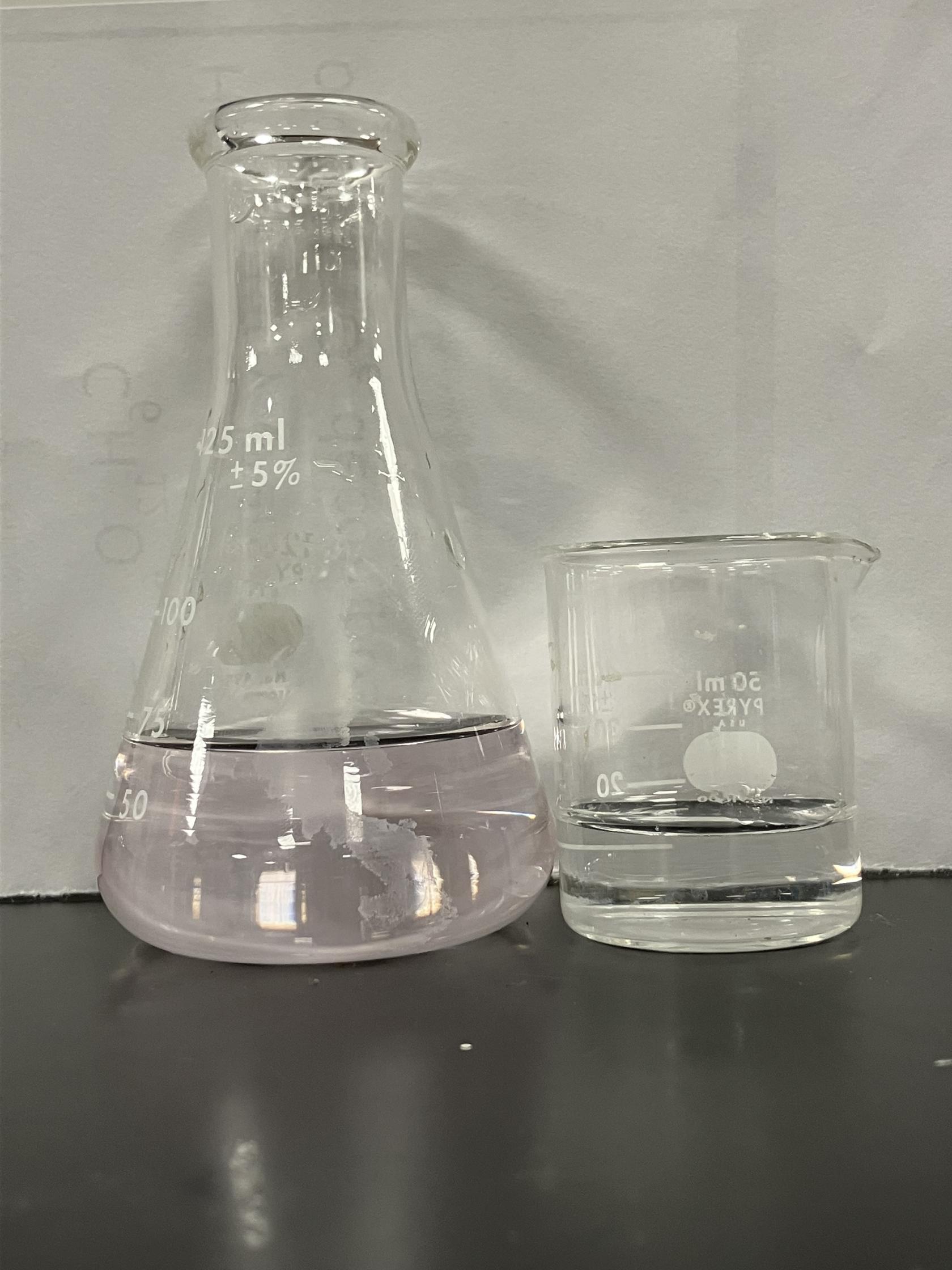
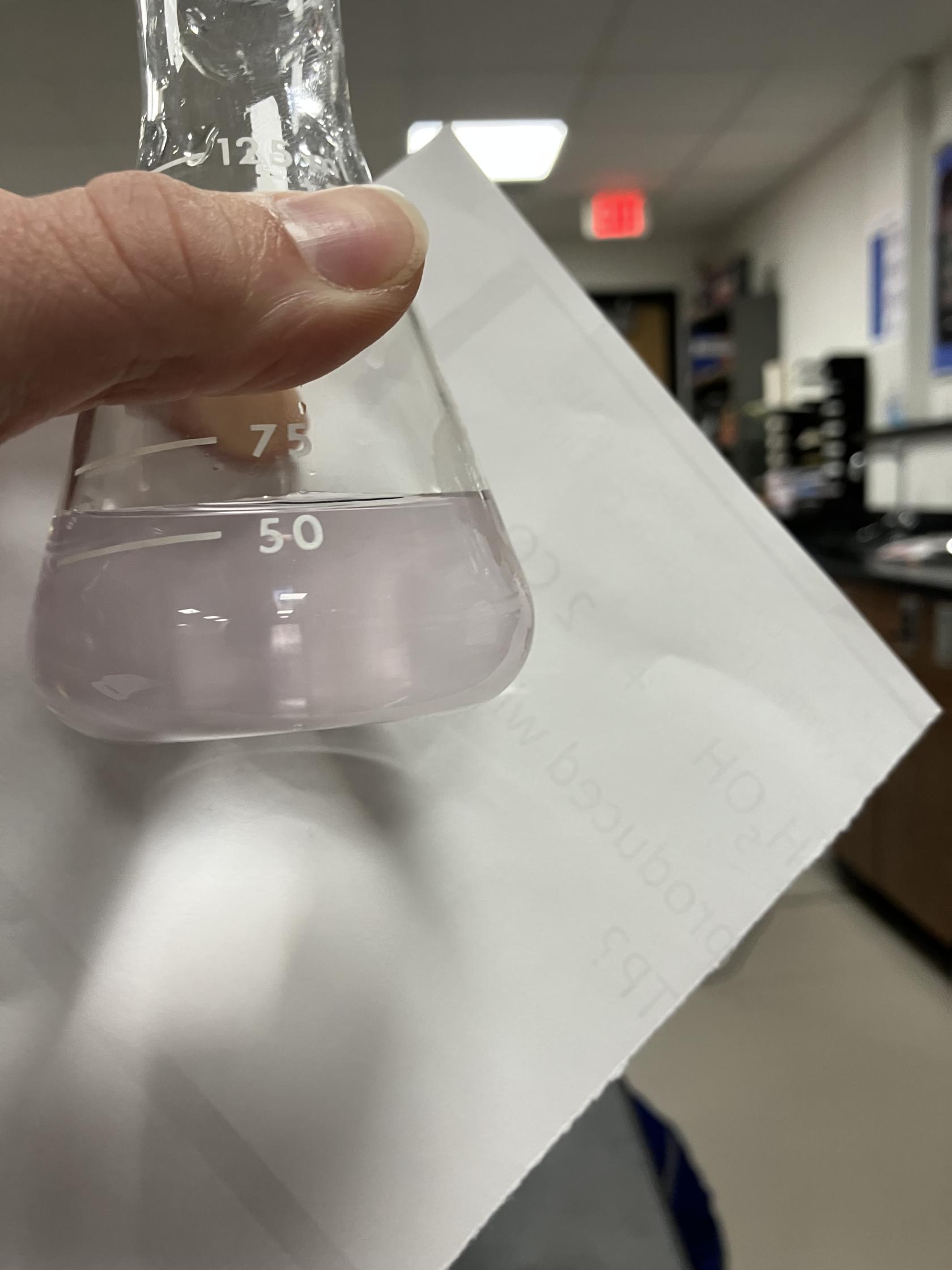
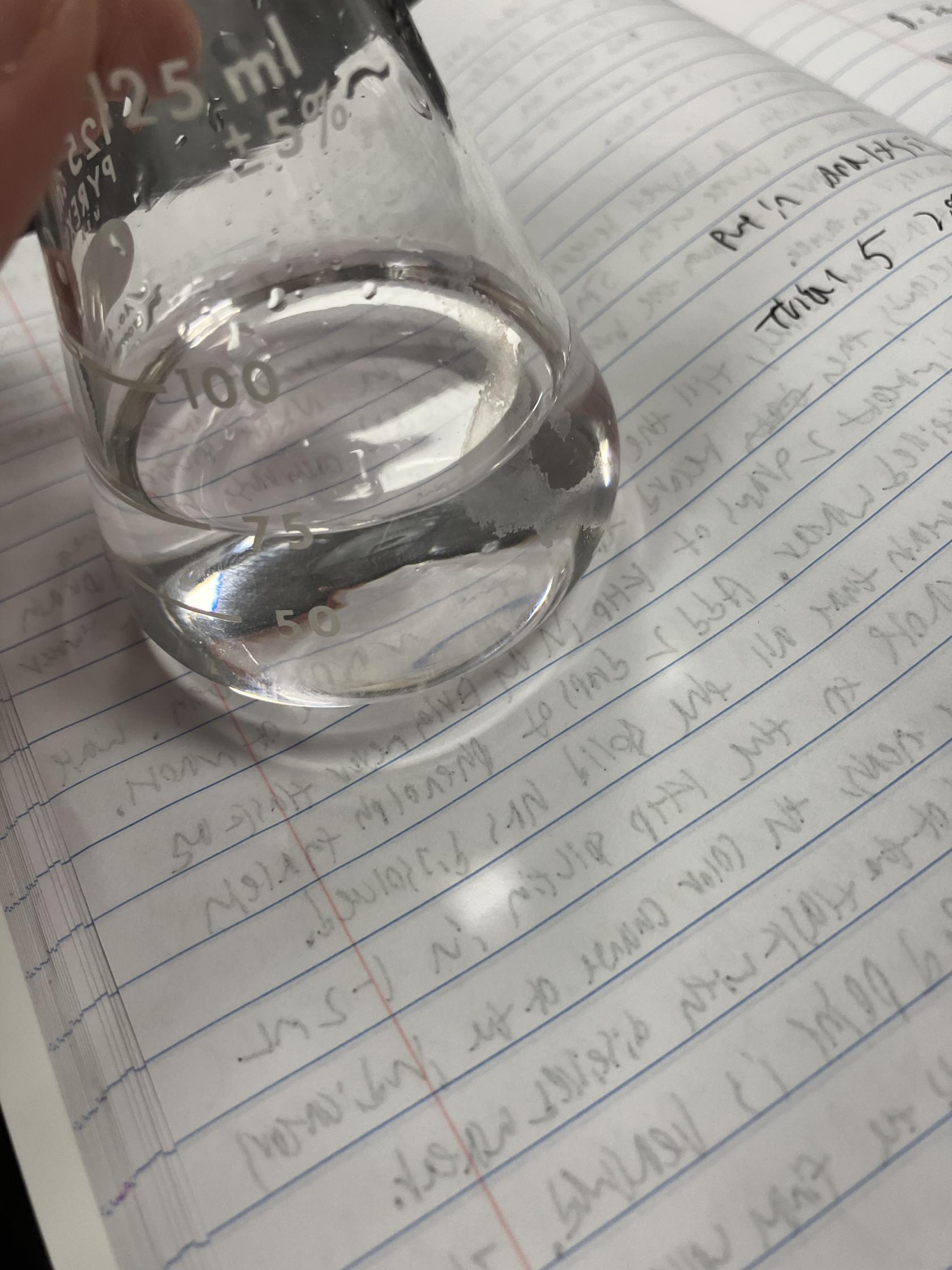
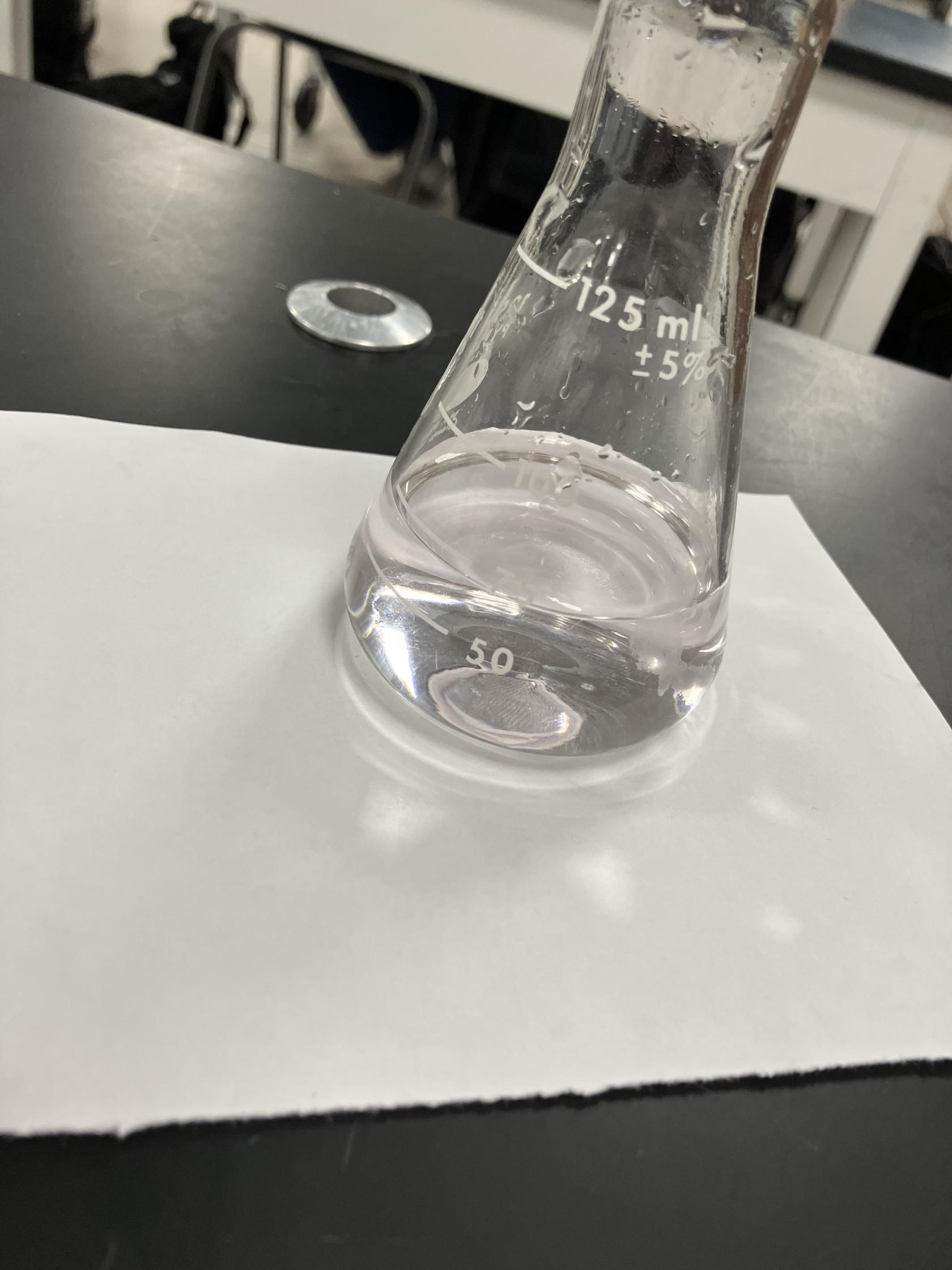
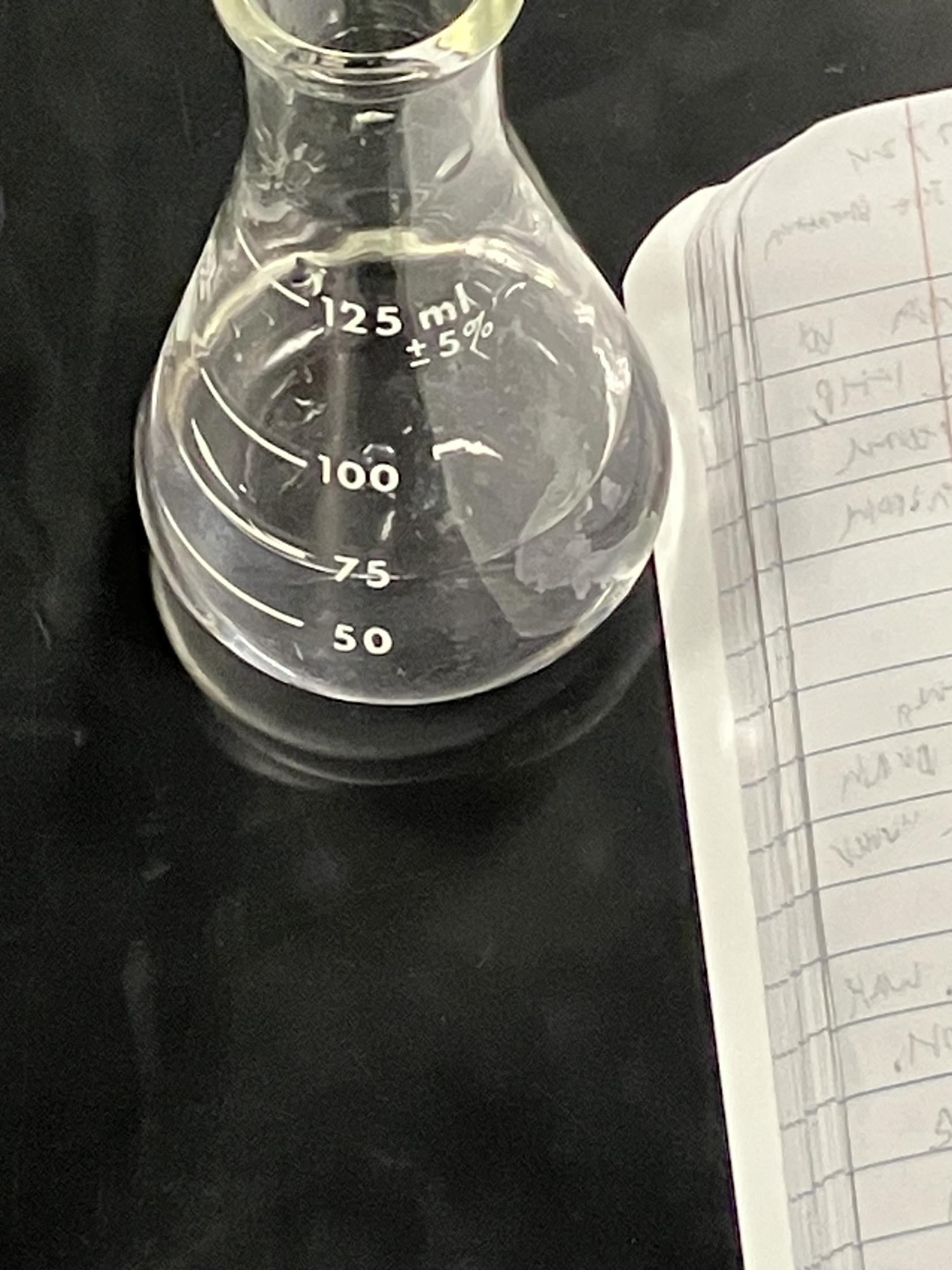
First trial turned a dark pink after about 10mL of NaOH. Way too dark. About a drop too much of NaOH. Trial 2 turned a dark pink, not as dark as trial 1. Trial 3 was similar to trial 2, same color and same amount of NaOH used. Magic numer seems to be 9.7mL when it turns pink. We lost a little bit of the KHP for the 4th trial. Trial 4 got a very very faint pink color. Even though we lost

some KHP, it looks near perfect titration. Trial 4 looked clear until help against white paper. Trial 5 was a dark pink, though better than 1, 2, and 3. 4th trial was the best out of the 5.

<details id="bkmrk-trial-4-img_5581.jpe"><summary>Trial 4</summary>

 [![IMG_5582.jpeg](https://bookstack.owen-andersen.com/uploads/images/gallery/2025-11/scaled-1680-/bNXimg-5582-jpeg.jpeg)](https://bookstack.owen-andersen.com/uploads/images/gallery/2025-11/scaled-1680-/bNXimg-5582-jpeg.jpeg)[![IMG_5581.jpeg](https://bookstack.owen-andersen.com/uploads/images/gallery/2025-11/scaled-1680-/QKtimg-5581-jpeg.jpeg)](https://bookstack.owen-andersen.com/uploads/images/gallery/2025-11/scaled-1680-/QKtimg-5581-jpeg.jpeg)[![IMG_5583.jpeg](https://bookstack.owen-andersen.com/uploads/images/gallery/2025-11/scaled-1680-/fphimg-5583-jpeg.jpeg)](https://bookstack.owen-andersen.com/uploads/images/gallery/2025-11/scaled-1680-/fphimg-5583-jpeg.jpeg)[![IMG_5580.jpeg](https://bookstack.owen-andersen.com/uploads/images/gallery/2025-11/scaled-1680-/kNBimg-5580-jpeg.jpeg)](https://bookstack.owen-andersen.com/uploads/images/gallery/2025-11/scaled-1680-/kNBimg-5580-jpeg.jpeg)[![IMG_5584.jpeg](https://bookstack.owen-andersen.com/uploads/images/gallery/2025-11/scaled-1680-/kaaimg-5584-jpeg.jpeg)](https://bookstack.owen-andersen.com/uploads/images/gallery/2025-11/scaled-1680-/kaaimg-5584-jpeg.jpeg)
</details>

# Page 24

Analysis: KHC<sub>8</sub>H<sub>4</sub>O<sub>4</sub>+NaOH-&gt;NaKC<sub>8</sub>H<sub>4</sub>O<sub>4</sub>+H<sub>2</sub>O

Trial 1:

10.00mL-0.20mL=<span style="text-decoration: underline;">9.80mL NaOH used</span>

2.00g/(39.10+1.008+8\*12.01+4\*1.008+4\*10.00)\*(1/1)\*(9.80/1000)=0.999~<span style="text-decoration: underline;">1.0M</span>

Trial 2:

19.70mL-10.00mL=<span style="text-decoration: underline;">9.70mL NaOH used</span>

2.00g/(39.10+1.008+8\*12.01+4\*1.008+4\*10.00)\*(1/1)\*(9.70/1000)=<span style="text-decoration: underline;">1.01M</span>

Trial 3:

29.40mL-19.70mL=<span style="text-decoration: underline;">9.7mL NaOH used</span>

2.00g/(39.10+1.008+8\*12.01+4\*1.008+4\*10.00)\*(1/1)\*(9.70/1000)=<span style="text-decoration: underline;">1.01M</span>

Trial 4:

39.15mL-29.40mL=<span style="text-decoration: underline;">9.75mL NaOH used</span>

2.00g/(39.10+1.008+8\*12.01+4\*1.008+4\*10.00)\*(1/1)\*(9.75/1000)=<span style="text-decoration: underline;">1.00M</span>

Trial 5:

48.85mL-39.15mL=<span style="text-decoration: underline;">9.70mL NaOH used</span>

2.00g/(39.10+1.008+8\*12.01+4\*1.008+4\*10.00)\*(1/1)\*(9.70/1000)=<span style="text-decoration: underline;">1.01M</span>

Average Molarity:

(1.00M+1.01M+1.01M+1.00M+1.01M)/5=1.006~<span style="text-decoration: underline;">1.01M on average</span>

% Deviation:

(1.01-1.00)/1.01 \*100=<span style="text-decoration: underline;">0.990% deviation</span>

Conclusion:

The purpose of the lab was to determine the molarity of an NaOH solution by reacting KHP with NaOH and getting as close to the endpoint as possible. We achieved this purpose by takings the before and after volume of the NaOH to when the enpoint is reached or passed, the difference of which was used to calculate the molarity of the NaOH solution. On average, 9.7mL was too far, though 9.75mL was used to get a near perfect titration. We got an average molarity of 1.01M NaOH. The target was about 1.00M.

# Page 25

Our % deviation was 0.990%, meaning our answers between each trial was pretty close to the average. Since we got one really good titration, the % deviation means we were really close to being exact and getting a light pink color, within a few hundreths of a milliliter. Some possible errors may include inaccurate recording of the NaOH solution in the buret, NaOH stick to the beaker or tip of the buret, we lost some KHP when transferring from the weight paper to the flask, and improperly cleaned flasks between trials. If I did it again, I would pay more attention to how long it takes for it to turn clear again to get a more accurate titration, be more careful so that everything measured gets mixed, and spending more time reading the buret and measuring out the reactants.